
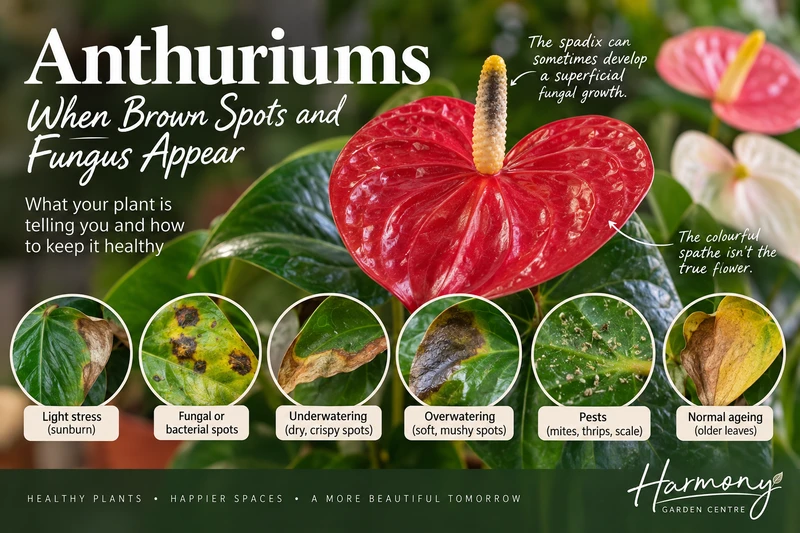
The Curious Fungal Phenomenon on Anthuriums
Anthuriums are pretty tough plants, but every now and then those beautiful glossy leaves can start developing brown spots.
And this is where things can get confusing.
You see a brown mark and immediately think, “I've got a fungal problem.”
But brown spots can be caused by a number of different things — watering, light, humidity, pests, physical damage, nutritional problems and, yes, fungal or bacterial diseases.
So before reaching for a spray, let's have a closer look.
Not every brown spot is a fungus
This is probably the most important thing to understand.
A brown spot is a symptom. It doesn't tell you what caused it.
The trick is to look at where the spot is, what it looks like, how quickly it is changing and what the plant has been experiencing.
Let's work through the common causes.
Watering problems
One of the first things I look at with an Anthurium is watering.
Too much water can cause problems because constantly wet conditions reduce the oxygen available to the roots. Once the roots are struggling, the plant becomes much more vulnerable to root problems and disease.
Overwatering can be associated with dark, soft or mushy areas, particularly when combined with poor drainage.
At the other end of the scale, allowing the plant to become excessively dry can produce brown, crispy patches or edges as the leaves lose moisture.
The answer isn't simply to water more or water less.
It's about finding the balance.
Make sure the pot drains properly and don't leave the plant sitting in water. Then allow the growing mix to dry slightly between waterings rather than keeping it permanently saturated.
Fungal and bacterial problems
Now we get to the part that often catches people's attention.
Anthuriums can suffer from fungal and bacterial diseases. Some, such as anthracnose caused by Colletotrichum, can produce brown to black lesions on leaves and flowers.
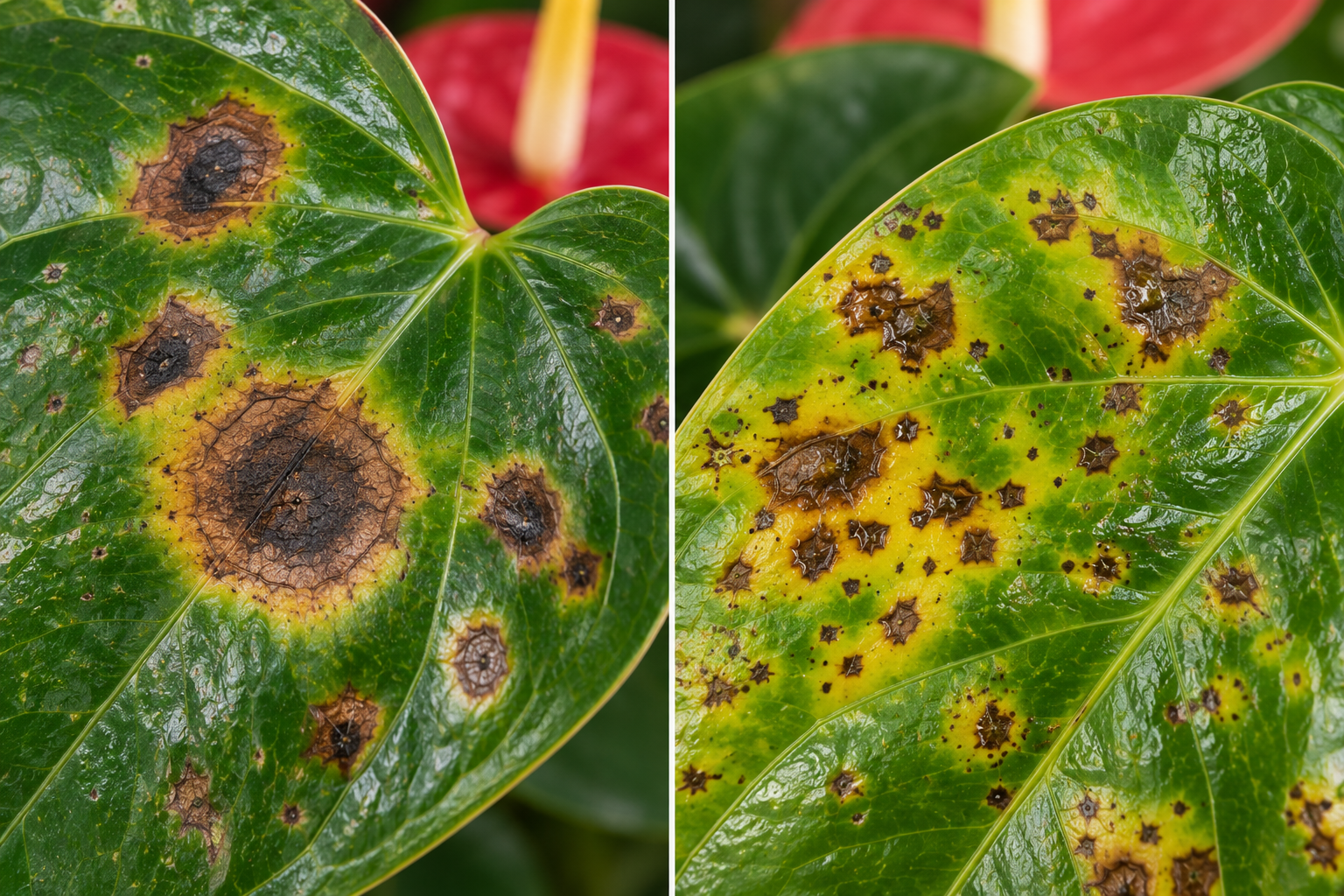
Bacterial diseases can also cause spotting, and some may produce yellow halos or water-soaked-looking areas.
The important thing is that these problems can spread and develop, rather than simply being an isolated brown mark.
If you notice spots that are enlarging, becoming darker, developing yellow margins or appearing on several leaves, take a closer look.
Good hygiene is important.
Remove badly affected leaves using clean, sharp scissors and dispose of them rather than leaving diseased material around the plant.
And try to keep water off the foliage where possible. Water splashing from one leaf to another can help move pathogens around.
Good air movement around the plant is also important.
What about that strange growth on the flower?
This is where Anthuriums get particularly interesting.
The colourful, heart-shaped part we call the flower is actually the spathe. The upright structure in the centre is the spadix, which contains the plant's tiny individual flowers.
Occasionally, a greyish or brownish superficial fungal growth can appear on the spadix.
And this doesn't automatically mean the Anthurium is diseased.
Some fungi can simply take advantage of moisture or substances naturally produced around the developing flowers.
So don't panic when you see something unusual.
Look underneath it.
Is the tissue itself healthy and firm?
Or is the spadix developing dark lesions, becoming soft or starting to rot?
That distinction is much more useful than simply asking whether there is fungus present.
Light can cause brown patches too
Anthuriums love bright light, but they don't necessarily love harsh, direct afternoon sun.
Put an Anthurium in strong direct sunlight and those beautiful leaves can scorch.
Sunburn often appears as dry, brown or bleached-looking patches, particularly on the parts of the leaf receiving the strongest sunlight.
If your plant is sitting right against a hot western or northern-facing window, try moving it back or filtering the light.
Anthuriums generally do best with bright, filtered or indirect light.
Interestingly, too little light doesn't usually produce brown spots by itself, but a plant growing in poor light may be weaker and less able to cope with other stresses.
Humidity matters
Remember where Anthuriums come from.
They're tropical plants, and they appreciate humidity.
When the air is very dry, you can see brown leaf edges, crispy tips and general deterioration of the foliage.
Increasing humidity can help, but don't confuse high humidity with keeping the leaves constantly wet.
That's an important distinction.
Good humidity combined with good airflow is much better than a stagnant, constantly damp environment.
A humidifier can help in a very dry room. Grouping plants together can also increase local humidity.
I'd be a little cautious about relying on frequent misting, though. If the foliage stays wet for long periods and air movement is poor, you're potentially creating conditions that favour disease rather than preventing it.
Don't forget the pests
Sometimes the culprit isn't a fungus at all.
Thrips, mites, scale and other pests can damage Anthurium leaves and leave behind discoloured or brown areas.
Get into the habit of looking underneath the leaves as well as on top.
Look for tiny insects, webbing, distorted new growth, sticky residue or the characteristic silvery or stippled damage that some pests leave behind.
The earlier you find a pest problem, the easier it is to deal with.
What about nutrients?
An Anthurium that isn't receiving adequate nutrition can also develop poor-quality foliage.
Nutritional problems don't always produce a simple, obvious brown spot, so I wouldn't automatically diagnose a nutrient deficiency just because you see browning.
Look at the plant as a whole.
Is new growth small or pale?
Are older leaves changing colour?
Is the plant generally lacking vigour?
Is it growing strongly but showing isolated damage on just one or two leaves?
These clues can help separate a nutritional problem from disease, watering or environmental stress.
A good-quality, balanced fertiliser used appropriately during active growth can help maintain healthy foliage, but more fertiliser isn't always better.
Over-fertilising can create its own problems.
Sometimes an old leaf is simply an old leaf
This is another one that gardeners can easily overlook.
Leaves don't live forever.
An older leaf may naturally develop some browning, yellowing or deterioration before the plant eventually sheds it.
If the older leaf is declining while the new growth is healthy, that's often much less concerning than brown spots appearing rapidly across the newest leaves.
Look at the new growth.
That's often one of the best indicators of how your Anthurium is really doing.
So how do you work out what's wrong?
When I see a plant with brown spots, I don't immediately ask, “What can I spray on it?”
I ask a few other questions first.
Where are the spots?
Are they dry and crispy or soft and wet?
Are they spreading?
Are they on old leaves or new growth?
Has the plant been too wet or too dry?
Has it been sitting in direct sunlight?
Is the air very dry?
Can I see pests?
Does the plant have good airflow?
Once you start looking at the whole plant rather than one brown spot, the answer becomes much easier to find.
The big lesson
Anthuriums don't need perfect conditions every minute of every day.
What they do need is the right balance.
Good light.
Good drainage.
Consistent watering.
Reasonable humidity.
Good airflow.
And regular observation.
And if you do find fungus, don't automatically assume you've got a disease that needs treating.
Sometimes it is a genuine pathogen that needs attention.
Sometimes it is simply a superficial organism taking advantage of the conditions around the plant.
And sometimes what you're looking at isn't fungus at all.
That's the fascinating thing about gardening.
The more closely you look, the more you realise the plant is actually giving you clues.
You just have to learn how to read them.